Breaking down the US midterm results
November 06, 2026
-
5 min

Products
Investment capabilities
Insights
In focus
Investor sentiment
Education


Coming into the 2026 midterms, Republicans held narrow majorities in both the House and Senate. While the minority party typically gains seats in a midterm – the minority party has taken the House in 3-in-4 elections since World War II – Democrats won more seats than many projected in both legislative bodies, gaining control of both the House and the Senate. While these results represent a major shift in Washington, policy may not change dramatically in practice given executive veto power. Political gridlock seems likely.
Key takeaways
Final tallies are still coming in for close contests, but the Senate was called early for Democrats, who flipped seats in Iowa, Kansas, Maine, North Carolina, Ohio, South Carolina, and Texas, and held all of their closely contested seats, including Georgia, Michigan, Minnesota, and New Hampshire. While the Senate races in Alaska and Mississippi have not been finalized — those results could take days or weeks — Democrats will control at least 54 Senate seats even as votes in these races are still being counted.
Democrats also secured the House early. Again, while dozens of races remain uncalled, redistricting did not help Republicans narrow the size of the Democrat majority, which could have them lead with a margin of as many as 30–40 seats.
Larger-than-expected majorities may make the jobs of presumed Speaker Jeffries and Leader Schumer easier, but without veto-proof or filibuster-proof majorities, any major legislation will still need the president’s support or some bipartisan agreement.
Markets tend to turn positive in the wake of elections as results become clear and uncertainty fades. Since 1979, the S&P 500® Index has returned about 16% on average in the year after a midterm, versus 10% across all years. Fundamentals still matter, however, and markets can’t be expected to enjoy outperformance after every election.
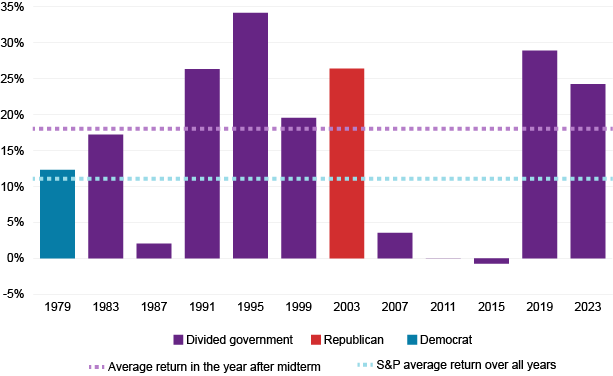
Source: Federal Reserve Economic Data and history.house.gov.
For investors, the policy outlook points more to sector-level effects than broad market shifts. Tariffs remain a source of uncertainty, as ongoing investigations could lead to new or expanded duties. Continued deregulation may be a tailwind for energy and financial services, and the lack of consensus on artificial intelligence (AI) makes broad regulation less likely. Meanwhile, voters made clear that affordability is a top priority, leaving healthcare and housing as key areas for policy to address.
For now, markets can set election uncertainty aside, even as attention turns to the 2028 race, which could shift the status quo in Washington again.
Without a deal by December 11, government funding will lapse and the NDAA will expire. Many outgoing members may not want to return to Washington for votes, and post-election tensions could derail both efforts. There is a real risk that neither funding nor the NDAA gets done, but there will also be pressure to clear the decks before January. Further complicating matters, the Republican Senate majority will narrow in December, when Senator-elect Sherrod Brown (D-Ohio) is seated early after winning a special election for an appointed seat.
In the next Congress, affordability will be a major priority for both parties, especially as they begin positioning for the 2028 presidential race. While each will hope to gain an edge here, there could be some bipartisan efforts on issues like healthcare and housing costs. The president may also be open to signing some legislation as he weighs his legacy.
Pressure is also building to address AI and data centers. Any efforts here are a concern for investors, given how much recent market performance has been driven by the AI trade. Still, consensus on AI has been hard to reach in Washington, making targeted actions on AI safety or data center energy use more likely than broad regulation.
The next Congress will also need to extend government funding and raise the debt ceiling before the Treasury runs out of borrowing room, expected in mid-to-late 2027. Both typically require 60 Senate votes to overcome a filibuster, and negotiations among Congressional Republicans, Democrats, and the White House could cause delays. While debt ceiling brinkmanship once rattled markets, investors have come to expect these disputes to be resolved.
The Democrat-led House is likely to focus heavily on investigations and oversight of the Trump administration and its agenda, leading to high-profile hearings. This could curb administration actions in areas that draw public scrutiny, but it is unlikely to stop them entirely, particularly in policy areas that are high conviction for the administration. The Senate majority also controls confirmations of judges, agency heads, and financial regulators, which could slow or reshape the administration’s nominations.
With Democrats controlling Congress, and the president focused on his legacy in his final two years, he is expected to continue using executive orders, especially for his signature priorities. President Trump signed more executive orders in the first half of his second term than in his entire first term. Presidents have relied increasingly on executive orders in recent terms, partly because slim or opposing majorities in Congress make legislating difficult.
The administration’s deregulatory agenda has also picked up in recent months, particularly in energy, the environment, and financial services. Expect this to continue, likely peaking in 2027 as regulators work to finalize rules before the Congressional Review Act lookback window opens in 2028. That window makes it easier for a future Congress to repeal rules finalized late in a presidential term.
The US midterms and your portfolio


As of November 4, 2026. The views and opinions contained herein reflect the subjective judgments and assumptions of the authors only and do not necessarily reflect the views of Natixis Investment Managers or any of its affiliates.
This material is provided for informational purposes only and should not be construed as investment advice. There can be no assurance that developments will transpire as forecasted. Actual results may vary. The views and opinions expressed may change based on market and other conditions. Natixis Investment Managers does not provide tax or legal advice. Please consult with a tax or legal professional prior to making any investment decisions.
Natixis Distribution, LLC is a limited purpose broker dealer and the distributor of various registered investment companies for which advisory services are provided by affiliates of Natixis Investment Managers.
Natixis Investment Managers includes all of the investment management and distribution entities affiliated with Natixis Distribution, LLC and Natixis Investment Managers International.
This document may contain references to copyrights, indexes and trademarks that may not be registered in all jurisdictions. Third-party registrations are the property of their respective owners and are not affiliated with Natixis Investment Managers or any of its related or affiliated companies (collectively “Natixis”). Such third-party owners do not sponsor, endorse or participate in the provision of any Natixis services, funds or other financial products.