Capital loss carryovers: The banking myth
August 14, 2026
-
4 min

Products
Investment capabilities
Insights
In focus
Investor sentiment
Education


Capital loss carryovers can offset future gains, but investors cannot simply save them for a chosen event. Tax rules, portfolio activity and unexpected gains may reduce the balance over time, making “banking losses” a useful but imperfect analogy.
Key takeaways
Direct indexing and other tax-aware strategies often emphasize the value of harvested capital losses. Advisors and asset managers may describe this process as “banking losses” or building a “war chest” of future tax deductions.
The analogy suggests that investors can harvest losses today, preserve them for years and use them when a large taxable gain occurs, such as the sale of a business, real estate or a concentrated stock position.
Capital loss carryovers do not work like money in a savings account. Investors cannot decide to leave them untouched until a specific event. Current-year losses and prior-year carryovers are applied against gains as they arise under the tax code’s netting rules.
Suppose an investor harvests a large loss in 2026 and hopes to use it against a major capital gain expected in 2030. Taxable gains realized between 2026 and 2029 would draw down that balance first, whether the gains were intentional or unexpected. They could include capital gain distributions from a mutual fund even if the investor sold no shares.
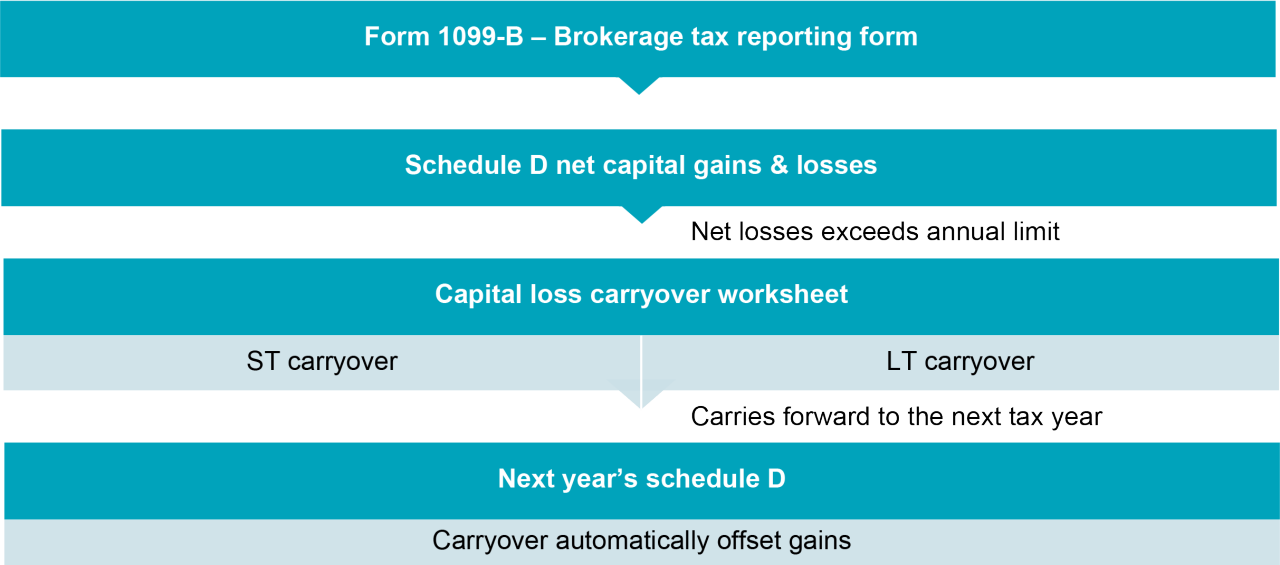
Schedule D is used to calculate capital gains and losses. It pulls in the prior year’s capital loss carryovers on lines 6 and 14, just before the net short-term (ST) and long-term (LT) gains or losses are determined for the current tax year as shown in Figure 1. See Figure 2 for an illustration of how losses flow from Form 1099-B through Schedule D and turn into loss carryovers.

For Illustrative Purposes only.
Many investors assume they can control when taxable gains occur. In reality, gains can arise from a variety of sources:
Each event can reduce available loss carryovers. Sticking with our analogy, think of it like this: a checking account where your kids have the ATM card. You know the money is there, but you never know exactly when it will disappear.
The annual capital loss deduction against ordinary income provides another example. If capital losses exceed capital gains, taxpayers may generally deduct up to $3,000 of net losses against ordinary income each year. Any remaining balance carries forward to future years and is tracked on the IRS’s Capital Loss Carryover Worksheet.
Taxpayers cannot forgo the deduction to preserve losses for a later date. Losses from prior years flow through to the current year’s Schedule D for calculating capital gains. If losses exceed gains, the lesser of the net loss, or $3,000, reduces income on Form 1040.
An interesting side note is that the $3,000 deduction limit has been static for nearly five decades. Part of the Tax Reform Act of 1976, the deduction limit started at $1,000, moved to $2,000 in 1977 and has remained at $3,000 since 1978. While many provisions of the tax code have been indexed for inflation over time, this one has not. Had it been tracking the Consumer Price Index, the deduction would be north of $15,000 in 2026.
The static limit means some investors accumulate carryovers that may take years to fully utilize. Figure 3 illustrates how annual gains, distributions, and the $3,000 deduction can steadily reduce a carryover balance before an investor reaches the gain event they originally intended to offset.
Another overlooked aspect of loss carryovers is that they aren’t permanent. While tax losses accumulate during one’s lifetime, unlike other financial assets, unused capital loss carryovers do not survive death.
Any losses available on a taxpayer’s final return may be used subject to the normal rules, but any remaining carryover balance is generally lost. It cannot be inherited or transferred to heirs or preserved for a surviving spouse. State rules vary on the treatment of loss carryovers, especially in community-property states.
This reality further weakens the “bank account” analogy. Cash in a bank account can be inherited; capital loss carryovers cannot.
None of this diminishes the value of tax loss harvesting. Harvested losses can provide meaningful tax benefits, improve after-tax wealth accumulation, and increase flexibility when managing future gains.
Those advantages remain among the strongest arguments for direct indexing and other tax-aware strategies. The issue is simply one of precision and word choice.
When we talk about “banking losses,” and “stacking losses,” we may unintentionally imply that taxpayers can store losses and withdraw them whenever they choose. In reality, future gains, tax rules, portfolio activity, and even mortality largely determine when and whether those losses are ultimately used.
Direct indexing can play a valuable role in a tax-efficient investment strategy, especially for high-net-worth investors. Let us help you create portfolios that put taxes first.


Natixis Investment Managers does not provide tax or legal advice. Please consult with a tax or legal professional prior to making any investment decisions.
The views and opinions expressed may change based on market and other conditions. This material is provided for informational purposes only and should not be construed as investment advice. There can be no assurance that developments will transpire as forecasted. Actual results may vary.
Any opinions or forecasts contained herein reflect the subjective judgments and assumptions of the authors only and do not necessarily reflect the views of Natixis Investment Managers or any of its affiliates.
CFA® and Chartered Financial Analyst® are registered trademarks owned by the CFA Institute.
Tax liability is the total amount of tax debt owed by an individual, corporation or other entity to a taxing authority.
Tax loss harvesting is a strategy for selling securities that have lost value to offset taxes on capital gains.
Tax alpha considers how an investment performed relative to its benchmark on a pretax and after-tax basis.
Capital gain is a rise in the value of a capital asset (investment or real estate) that gives it a higher value than the purchase price.
Investing involves risk, including risk of loss. Investment risk exists with equity, fixed-income, and alternative investments. There is no assurance that any investment will meet its performance objectives or that losses will be avoided.
This document may contain references to copyrights, indexes and trademarks that may not be registered in all jurisdictions. Third-party registrations are the property of their respective owners and are not affiliated with Natixis Investment Managers or any of its related or affiliated companies (collectively “Natixis”). Such third-party owners do not sponsor, endorse or participate in the provision of any Natixis services, funds or other financial products.