Tariff effects on inflation set to fade
October 14, 2026

Products
Investment capabilities
Insights
In focus
Investor sentiment
Education
Tariffs have been a meaningful contributor to inflation over the past year, but that pressure may begin to ease in the months ahead. The bulk of tariff-related price increases have already worked their way through the economy, leaving a smaller contribution that should gradually fade from year-over-year inflation readings, according to St. Louis Fed research.
"But the story here is that you're still running at about 40 basis points contribution to excess inflation coming from tariffs,” says Garrett Melson, CFA®, Portfolio Strategist at Natixis Investment Managers Solutions. “And assuming that we stay at a status quo, that's 40 basis points of that year-over-year print that's going to roll off over the next 12 months here."
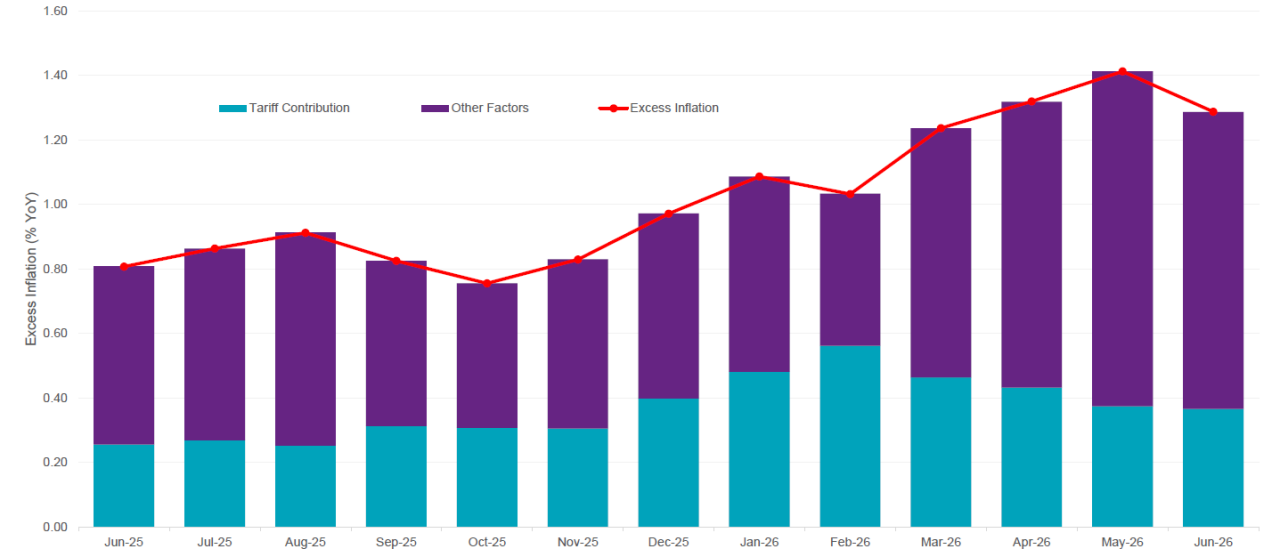 Source: Portfolio Analysis & Consulting. Federal Reserve Bank of St. Louis. Excess inflation defined as difference between Core PCE and the Federal Open Market Committee’s (FOMC) 2% target.
Core PCE is a measure of U.S. inflation that strips out food and energy prices to reveal the underlying trend in what consumers pay for everything else.
FOMC is The Federal Reserve committee responsible for setting U.S. monetary policy and guiding interest-rate decisions.
CFA® and Chartered Financial Analyst® are registered trademarks owned by the CFA Institute.
This material is provided for informational purposes only and should not be construed as investment advice. The views and opinions contained herein reflect the subjective judgments and assumptions of the authors only and do not necessarily reflect the views of Natixis Investment Managers, or any of its affiliates. The views and opinions expressed may change based on market and other conditions. There can be no assurance that developments will transpire as forecasted, and actual results may vary.
All investing involves risk, including the risk of loss. Investment risk exists with equity, fixed income, and alternative investments. There is no assurance that any investment will meet its performance objectives or that losses will be avoided. Investors should fully understand the risks associated with any investment prior to investing.