Consumer spending to converge with income growth
September 02, 2026

Products
Investment capabilities
Insights
In focus
Investor sentiment
Education
Consumer spending has remained surprisingly strong this year, even though income growth has lagged. That disconnect may not last much longer. While real personal income has begun to improve, several temporary tailwinds that supported consumers earlier this year are beginning to fade. "With real income growth remaining anemic as the World Cup, Prime Day, and tax refund fiscal impulse grow ever smaller in the rearview mirror, consumption is likely to moderate once more as another convergence between spending and incomes looks likely to play out in the back half of the year," says Garrett Melson, CFA®, Portfolio Strategist at Natixis Investment Managers Solutions.
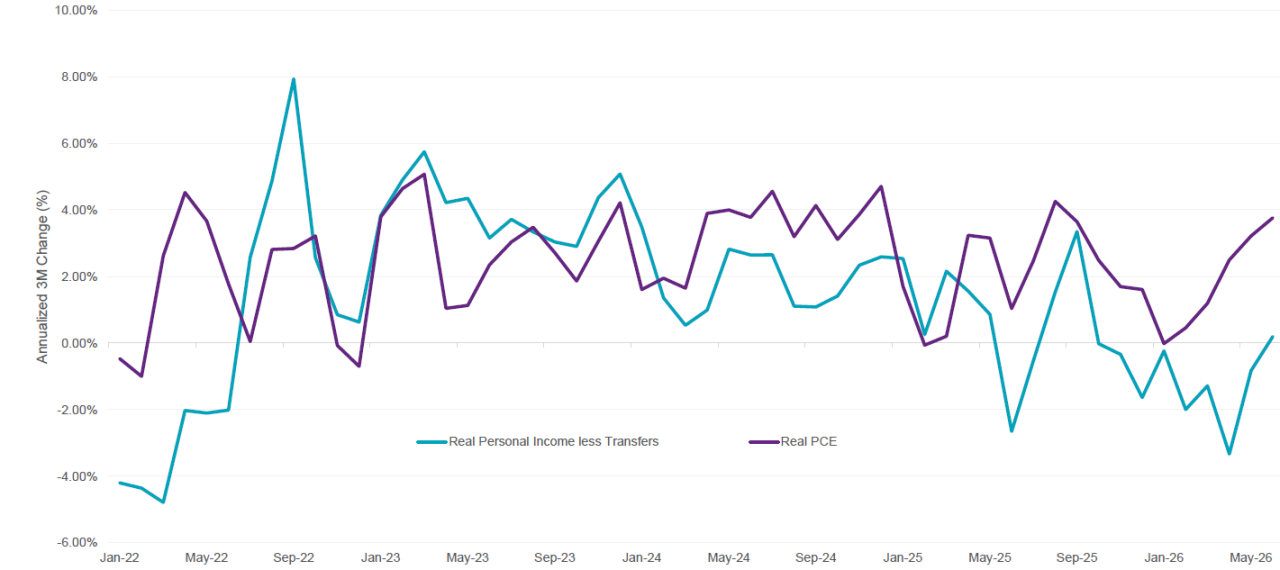 Source: Portfolio Analysis & Consulting; Bloomberg. PCE is personal consumption expenditures.
CFA® and Chartered Financial Analyst® are registered trademarks owned by the CFA Institute.
This material is provided for informational purposes only and should not be construed as investment advice. The views and opinions contained herein reflect the subjective judgments and assumptions of the authors only and do not necessarily reflect the views of Natixis Investment Managers, or any of its affiliates. The views and opinions expressed may change based on market and other conditions. There can be no assurance that developments will transpire as forecasted, and actual results may vary.
All investing involves risk, including the risk of loss. Investment risk exists with equity, fixed income, and alternative investments. There is no assurance that any investment will meet its performance objectives or that losses will be avoided. Investors should fully understand the risks associated with any investment prior to investing.