The strategic role of metals and the mining industry in a changing economy
July 29, 2026
-
10 min

Capabilities
Find out more about our investment capabilities
Services
Find out more about the full scope of our solutions offering

Funds
Search for funds, documents, and notifications
Funds by asset class
Search for funds within each asset class
Funds by investment manager
Find funds run by each of our affiliated investment managers
Insights by asset class
Gain our perspectives and investment thinking across each asset class
News and insights
Get deep insight and expert views on the forces shaping financial markets
Who we are
Find out more about who we are and how we might be able to help
Investor sentiment
Discover the latest insights from the center for investor insight


Metals and mining sit at the center of several long-term secular themes, including the energy transition, electrification, digital infrastructure, industrial resilience, and national security. As essential inputs for modern economies and the sustainable transition, the sector is increasingly becoming a strategic component of long-term economic growth.
As critical minerals become more essential to the global economy, scaling supply responsibly remains a major challenge. Supply remains constrained by geographic concentration, regulatory challenges, and long project timelines. At the same time, the sector faces significant environmental and social risks, reinforcing the need for responsible mining practices.
These dynamics are transforming minerals from a traditional commodity story into a strategic investment theme centered on security of supply, industrial competitiveness, and sustainable resource development.
Energy transition: Renewable power generation, battery storage, electric vehicles, and modern grid infrastructure are more mineral intensive than conventional energy systems. As countries invest in decarbonization, demand for copper, lithium, nickel, graphite, rare earths, aluminum, and other critical materials continues to rise.
By 2040, mineral demand from clean energy technologies is expected to increase between twofold to fourfold1.
Electrification: Electric mobility, charging networks, industrial electrification, and expanded transmission networks all require significant volumes of metals. Copper is essential for electricity transmission, power distribution, motors, chargers, renewable generation, and data center infrastructure while aluminum supports grids and transport.
A typical electric car requires six times the mineral inputs of a conventional car2.
AI and digitization: AI and digital infrastructure are emerging sources of mineral demand and are reshaping metals value chains. Data centers are particularly resource intensive, requiring large amounts of electricity, power equipment, cooling systems, semiconductors, and connectivity infrastructure in addition to metals such as copper, aluminum, specialty steels, and advanced materials. The growth of AI also reinforces the need for expanded electricity networks.
AI infrastructure is much more resource intensive than traditional cloud, requiring 65-70 tons of metals per MW, largely in power and cooling systems3.
Reindustrialization and supply chain resilience: Critical minerals have become a strategic priority as countries seek to strengthen domestic manufacturing, reduce supply-chain dependencies, and support industrial competitiveness.
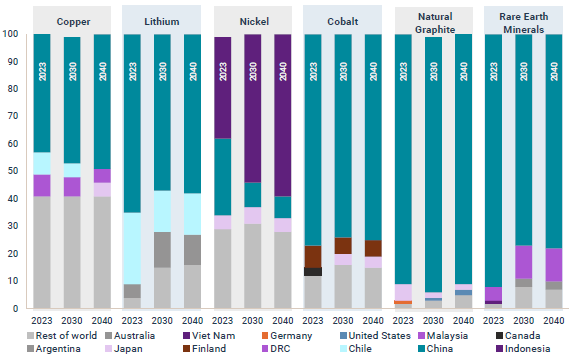
China’s share of refining is around 35% for nickel, 50-70% for lithium and cobalt, and nearly 90% for rare earth elements4.
Defense and security: Minerals also support defense and security applications including advanced electronics, aircraft, vehicles, communications systems, and guided technologies.
More than 60 strategic plans to ensure mineral supply reliability and resiliency are currently in place across major economies5.
Rising structural demand combined with constrained and geographically concentrated supply are creating long-term opportunities across the minerals and mining sector. Meeting this demand will require substantial investment across the value chain, from new mines and refining capacity to infrastructure, processing, and recycling.
However, supply is difficult to scale quickly. Even where mineral resources are available, the ability to develop them responsibly, sustainably, and within a reasonable timeframe remains a bottleneck for the industry.
On average, new mining projects take over 16 years to start producing minerals6.
The sector’s geographic concentration creates additional supply chain risk, as critical mineral mining is heavily concentrated in a small number of countries.
The average market share of the top three mining nations for key energy minerals rose from 73% in 2020 to 77% in 20247.
The market is even more concentrated when it comes to refining. The top three refining countries increased their combined market share from 82% in 2020 to 86% in 2024, driven largely by Indonesia in nickel and China in cobalt, graphite, and rare earths8.
Critical minerals are increasingly being used as instruments of trade policy and geopolitical influence. The growing US-China trade conflict has demonstrated that access to minerals can be weaponized with China imposing export controls on materials such as gallium, germanium, and graphite in response to Western technology restrictions.
There were 3x more critical raw-material export restrictions in 2025 versus 20249.
In response, governments across North America and Europe are using major policy initiatives such as the US Inflation Reduction Act (2022) and the EU Critical Raw Materials Act (2023) to strengthen supply security through domestic production, friend-shoring, recycling, and strategic partnerships while maintaining environmental and social standards.
Recycling and circularity are also becoming increasingly important, and we see strong long-term opportunities in this space as it can help reduce pressure on primary extraction, improve supply security, lower environmental impacts, and create new business models across the value chain.

Aluminum demand continues to rise across traditional uses such as construction and manufacturing as well as energy transition applications including solar infrastructure, electric vehicles, and grid expansion. Aluminum production is highly energy- and emissions-intensive, so recycling represents a significant opportunity to reduce environmental impact and strengthen supply.
Lithium is essential for lithium-ion batteries used in EVs and energy storage. Demand is expected to rise from ~205kt in 2024 to ~700 kt by 203510. Despite near-term oversupply, the current project pipeline points to a potential 40% deficit, requiring continued investment and an estimated 55 additional average-sized mines.
Copper stands out as one of the most significant supply bottlenecks of the energy transition. Copper is essential for electrification, supporting grids, renewables, EVs, charging networks, data centers, and industrial power systems. Demand is expected to rise as electricity plays a larger role in final energy consumption. The IEA (International Energy Agency) estimates that demand will grow from 27Mt in 2024 to 33Mt by 2035 and 37Mt by 2050. However, supply growth is struggling to keep pace as the industry faces declining ore grades, reserve depletion, rising capital costs, permitting challenges, and a lack of major new discoveries. As a result, the IEA estimates a potential 30% supply deficit before even considering more ambitious electrification scenarios. Recycling can help ease shortages as copper can be reused repeatedly without losing its properties and already supports one of the world’s largest recycling markets.
Steel is necessary for wind turbines, transmission towers, solar infrastructure, and broader clean energy build out. Supply is relatively resilient, but decarbonizing steel production remains a key challenge.
Manganese is mainly used in steel making, but it is also an input for lithium-ion batteries. Demand for manganese is rising with battery growth driven by EVs and grid storage systems.
Rare earths demand is expected to grow 50-60% by 2040 driven by permanent magnets used in EVs, wind turbines, and industrial motors11. While announced projects should broadly meet demand, supply chains remain highly concentrated, making rare earths a significant supply security risk due to China’s dominant position across the value chain.
Extraction (ore/concentrate): Critical minerals are typically extracted through underground or open-pit mining.
Processing (smelting/refining): After extraction and concentration, critical minerals are smelted and refined into saleable materials through processes that vary by mineral (high temperature processes, brine-extraction, electrolyzing). Processing is the most energy-intensive part of the supply chain. It also generates tailings (a slurry waste) from ore processing and impurity removal which are stored in dedicated facilities and can pose environmental and health risks if not properly managed.
Recycling: Given increased demand for critical minerals and geopolitical vulnerabilities in the supply chain, recycling will likely become a more important source of materials. According to the IEA, recycling could reduce new mining requirements for key minerals by 10–30%. While recycling is well established for base metals such as steel and aluminum, it remains much less developed for rare earth elements and other critical minerals. In the US, 57% of aluminum, 35% of copper, and 16% of silver were recycled in 2023 compared with estimated global recycling rates of only 5–10% for rare earth elements12.
Demand for critical minerals is rising to support future economies; however, this demand must be met with stronger responsible mining practices. This creates a clear transition paradox: while these minerals are essential enablers of the climate transition, their extraction and processing carry significant ESG risks.
Mining is highly resource-intensive, contributing to greenhouse gas emissions, pressure on local water resources, biodiversity loss, pollution, and long-term ecosystem impacts. These environmental risks are amplified when operations are located in water-stressed or biodiversity-sensitive areas and can translate into financial risks by delaying projects, increasing capex needs, or affecting companies’ licenses to operate. The sector is also associated with human rights concerns including weak governance, worker safety risks, challenging working conditions, community opposition, and impacts on Indigenous Peoples and local communities, which have made it prone to controversy over the years. As a result, the sector requires careful sustainability assessment to understand and manage the full impact of the sector’s value chain.
De-risking global critical mineral supply chains remains a long-term challenge, but the urgency is growing. Our approach combines strict minimum standards covering fossil fuel exposure, operations in high-risk countries, and breaches of international norms such as the UN Global Compact and OECD Guidelines. We conduct in-depth qualitative analysis to understand how companies may be positioned to manage these risks and contribute credibly to the transition. This analysis is not only relevant for companies involved in mining activities, but for other industries and value chains that rely on the sector as a material input.
Responsible mining practices are increasingly guided by recognized standards and frameworks, such as the Initiative for Responsible Mining Assurance (IRMA), which works with both corporate and community stakeholders to raise the bar on environmental and social standards for mining. Leading companies are adhering to these frameworks and working to lower operational emissions, improve energy efficiency, protect biodiversity through better site planning and rehabilitation, and invest in cleaner equipment and technologies. Recycling and circularity will also play a critical role by reducing pressure on primary extraction and improving supply security.
However, most standards remain voluntary and unevenly applied. For this reason, engagement is an important lever for encouraging more sustainable practices and managing sustainability risks. Many mining companies are key targets for collaborative engagement initiatives (e.g., Climate Action 100+, Nature Action 100, PRI Advance), reflecting both their significant environmental and social footprint and the potential for engagement to drive improvements. However, the sector’s structurally high ESG risks mean engagement alone may not be sufficient to reduce risks. Engagement should therefore be complemented by additional levers, including strong investment selection, escalation strategies where progress is insufficient, and support for stronger regulation and industry-wide transparency.
Written in July 2026 by Marine Michiels, Equity Analyst, Sustainable Equity Team, Mirova


1 IEA (2021), The Role of Critical Minerals in Clean Energy Transitions, IEA, Paris.
2 IEA (2021), The Role of Critical Minerals in Clean Energy Transitions, IEA, Paris.
3 BofA – Transition Investing – Matter over mind? AI’s 10 secret ingredients.
4 IEA (2021), The Role of Critical Minerals in Clean Energy Transitions, IEA, Paris.
5 JP Morgan – Critical minerals: Unearthing alpha across equities and credit.
6 JP Morgan – Critical minerals: Unearthing alpha across equities and credit.
7 IEA (2025), Global Critical Minerals Outlook 2025, IEA, Paris.
8 International Energy Agency (IEA).
9 Global Trade Alert. Import and Export Restrictions: Critical Minerals.
10 International Energy Agency (IEA).
11 International Energy Agency (IEA).
12 U.S. Geological Survey. (n.d.). Recycling statistics and information. National Minerals Information Center.
The securities mentioned above are shown for illustrative purpose only and should not be considered as a recommendation or a solicitation to buy or sell. The information provided reflects MIROVA’s opinion as of the date of this document and is subject to change without notice. The reported data reflect the situation as of the date of this document and are subject to change without notice. This information is intended for professional clients as defined by MiFID.
This material has been provided for information purposes only to investment service providers or other Professional Clients, Qualified or Institutional Investors and, when required by local regulation, only at their written request. This material must not be used with Retail Investors.
In the E.U.: Provided by Natixis Investment Managers International or one of its BRANCH offices listed below. Natixis Investment Managers International is a portfolio management company authorized by the Autorité des Marchés Financiers (French Financial Markets Authority - AMF) under no. GP 90-009, and a simplified joint-stock company (société par actions simplifiée - SAS) registered in the Paris Trade and Companies Register under no. 329 450 738, Registered office: 43 avenue Pierre Mendès France, 75013 Paris. Germany: Natixis Investment Managers International, Zweigniederlassung Deutschland (Registration number: HRB 129507). Registered office: Senckenberganlage 21, 60325 Frankfurt am Main. Italy: Natixis Investment Managers International Succursale Italiana (Registration number: MI-2637562). Registered office: Via Adalberto Catena, 4, 20121 Milan, Italy. Netherlands: Natixis Investment Managers International, Dutch BRANCH (Registration number: 000050438298), Registered office: Stadsplateau 7, 3521AZ Utrecht, the Netherlands. Spain: Natixis Investment Managers International S.A., Sucursal en España (Registration number: NIF W0232616C), Registered office: Serrano n°90, 6th Floor, 28006 Madrid, Spain. Luxembourg: Natixis Investment Managers International, Luxembourg BRANCH (Registration number: B283713), Registered office: 2, rue Jean Monnet, L-2180 Luxembourg, Grand Duchy of Luxembourg. Belgium: Natixis Investment Managers International, Belgian BRANCH (Registration number: 1006.931.462), Gare Maritime, Rue Picard 7, Bte 100, 1000 Bruxelles, Belgium.
In Switzerland: Provided for information purposes only by Natixis Investment Managers, Switzerland Sàrl (Registration number: CHE-114.271.882), Rue du Vieux Collège 10, 1204 Geneva, Switzerland or its representative office in Zurich, Schweizergasse 6, 8001 Zürich.
In the British Isles: Provided by Natixis Investment Managers UK Limited which is authorised and regulated by the UK Financial Conduct Authority (FCA firm reference no. 190258) - registered office: Natixis Investment Managers UK Limited, Level 4, Cannon Bridge House, 25 Dowgate Hill, London, EC4R 2YA. When permitted, the distribution of this material is intended to be made to persons as described as follows: in the United Kingdom: this material is intended to be communicated to and/or directed at investment professionals and professional investors only; in Ireland: this material is intended to be communicated to and/or directed at professional investors only; in Guernsey: this material is intended to be communicated to and/or directed at only financial services providers which hold a license from the Guernsey Financial Services Commission; in Jersey: this material is intended to be communicated to and/or directed at professional investors only; in the Isle of Man: this material is intended to be communicated to and/or directed at only financial services providers which hold a license from the Isle of Man Financial Services Authority or insurers authorised under section 8 of the Insurance Act 2008.
In the DIFC: Provided in and from the DIFC financial district by Natixis Investment Managers Middle East (DIFC BRANCH) which is regulated by the DFSA. Related financial products or services are only available to persons who have sufficient financial experience and understanding to participate in financial markets within the DIFC, and qualify as Professional Clients or Market Counterparties as defined by the DFSA. No other Person should act upon this material. Registered office: Unit L10-02, Level 10 ,ICD Brookfield Place, DIFC, PO Box 506752, Dubai, United Arab Emirates
In Japan: Provided by Natixis Investment Managers Japan Co., Ltd. Registration No.: Director-General of the Kanto Local Financial Bureau (kinsho) No.425. Content of Business: The Company conducts investment management business, investment advisory and agency business and Type II Financial Instruments Business as a Financial Instruments Business Operator.
In Taiwan: Provided by Natixis Investment Managers Securities Investment Consulting (Taipei) Co., Ltd., a Securities Investment Consulting Enterprise regulated by the Financial Supervisory Commission of the R.O.C. Registered address: 34F., No. 68, Sec. 5, Zhongxiao East Road, Xinyi Dist., Taipei City 11065, Taiwan (R.O.C.), license number 2020 FSC SICE No. 025, Tel. +886 2 8789 2788.
In Singapore: Provided by Natixis Investment Managers Singapore Limited (NIM Singapore) having office at 5 Shenton Way, #22-05/06, UIC Building, Singapore 068808 (Company Registration No. 199801044D) to distributors and qualified investors for information purpose only. NIM Singapore is regulated by the Monetary Authority of Singapore under a Capital Markets Services Licence to conduct fund management activities and is an exempt financial adviser. Mirova Division (Business Name Registration No.: 53431077W) and Ostrum Division (Business Name Registration No.: 53463468X) are part of NIM Singapore and are not separate legal entities. This advertisement or publication has not been reviewed by the Monetary Authority of Singapore.
In Hong Kong: Provided by Natixis Investment Managers Hong Kong Limited to professional investors for information purpose only.
In Australia: Provided by Natixis Investment Managers Australia Pty Limited (ABN 60 088 786 289) (AFSL No. 246830) and is intended for the general information of financial advisers and wholesale clients only.
In New Zealand: This document is intended for the general information of New Zealand wholesale investors only and does not constitute financial advice. This is not a regulated offer for the purposes of the Financial Markets Conduct Act 2013 (FMCA) and is only available to New Zealand investors who have certified that they meet the requirements in the FMCA for wholesale investors. Natixis Investment Managers Australia Pty Limited is not a registered financial service provider in New Zealand.
In Korea: Provided by Natixis Investment Managers Korea Limited (Registered with Financial Services Commission for General Private Collective Investment Business) to distributors and qualified investors for information purpose only.
In Colombia: Provided by Natixis Investment Managers International Oficina de Representación (Colombia) to professional clients for informational purposes only as permitted under Decree 2555 of 2010. Any products, services or investments referred to herein are rendered exclusively outside of Colombia. This material does not constitute a public offering in Colombia and is addressed to less than 100 specifically identified investors.
In Latin America: Provided by Natixis Investment Managers International.
In Chile: Esta oferta privada se inicia el día de la fecha de la presente comunicación. La presente oferta se acoge a la Norma de Carácter General N° 336 de la Superintendencia de Valores y Seguros de Chile. La presente oferta versa sobre valores no inscritos en el Registro de Valores o en el Registro de Valores Extranjeros que lleva la Superintendencia de Valores y Seguros, por lo que los valores sobre los cuales ésta versa, no están sujetos a su fiscalización. Que por tratarse de valores no inscritos, no existe la obligación por parte del emisor de entregar en Chile información pública respecto de estos valores. Estos valores no podrán ser objeto de oferta pública mientras no sean inscritos en el Registro de Valores correspondiente.
In Mexico: Provided by Natixis IM Mexico, S. de R.L. de C.V., which is not a regulated financial entity, securities intermediary, or an investment manager in terms of the Mexican Securities Market Law (Ley del Mercado de Valores) and is not registered with the Comisión Nacional Bancaria y de Valores (CNBV) or any other Mexican authority. Any products, services or investments referred to herein that require authorization or license are rendered exclusively outside of Mexico. While shares of certain ETFs may be listed in the Sistema Internacional de Cotizaciones (SIC), such listing does not represent a public offering of securities in Mexico, and therefore the accuracy of this information has not been confirmed by the CNBV. Natixis Investment Managers is an entity organized under the laws of France and is not authorized by or registered with the CNBV or any other Mexican authority. Any reference contained herein to “Investment Managers” is made to Natixis Investment Managers and/or any of its investment management subsidiaries, which are also not authorized by or registered with the CNBV or any other Mexican authority.
In Uruguay: Provided by Natixis Investment Managers Uruguay S.A. Office: San Lucar 1491, Montevideo, Uruguay, CP 11500. The sale or offer of any units of a fund qualifies as a private placement pursuant to section 2 of Uruguayan law 18,627.
In Brazil: Provided to a specific identified investment professional for information purposes only by Natixis Investment Managers International. This communication cannot be distributed other than to the identified addressee. Further, this communication should not be construed as a public offer of any securities or any related financial instruments. Natixis Investment Managers International is a portfolio management company authorized by the Autorité des Marchés Financiers (French Financial Markets Authority - AMF) under no. GP 90-009, and a simplified joint-stock company (société par actions simplifiée - SAS) registered in the Paris Trade and Companies Register under no. 329 450 738. Registered office: 43 avenue Pierre Mendès France, 75013 Paris.
The above referenced entities are business development units of Natixis Investment Managers, the holding company of a diverse line-up of specialised investment management and distribution entities worldwide. The investment management subsidiaries of Natixis Investment Managers conduct any regulated activities only in and from the jurisdictions in which they are licensed or authorized. Their services and the products they manage are not available to all investors in all jurisdictions.
Although Natixis Investment Managers believes the information provided in this material to be reliable, including that from third party sources, it does not guarantee the accuracy, adequacy, or completeness of such information.
The provision of this material and/or reference to specific securities, sectors, or markets within this material does not constitute investment advice, or a recommendation or an offer to buy or to sell any security, or an offer of any regulated financial activity. Investors should consider the investment objectives, risks and expenses of any investment carefully before investing. The analyses, opinions, and certain of the investment themes and processes referenced herein represent the views of the individual(s) as of the date indicated. These, as well as the portfolio holdings and characteristics shown, are subject to change and cannot be construed as having any contractual value. There can be no assurance that developments will transpire as may be forecasted in this material. The analyses and opinions expressed by external third parties are independent and does not necessarily reflect those of Natixis Investment Managers. Any past performance information presented is not indicative of future performance.
This material may not be distributed, published, or reproduced, in whole or in part.
All amounts shown are expressed in USD unless otherwise indicated.